Giant Killers -- Bring on No. 1
October 16, 2017 | Football
Oregon State University Athletics is proudly celebrating the 50th anniversary of the famed "Giant Killers" football team. Led by the late head coach Dee Andros, Oregon State posted a 7-2-1 record that included victories over No. 1 ranked USC, No. 2 Purdue and then a tie with the new No. 2 team in the land UCLA.
Historian Kip Carlson is in the midst of writing a six-part series on the team that originally prints in the gameday program that is available at Reser Stadium.
The Giant Killers were honored at the Oct. 14 game vs. Colorado.
Bring on No. 1
It didn't take long for Dee Andros to issue the challenge: "We're tired of fooling around with these Number 2 teams – bring on Number 1!"
It was the afternoon of November 4, 1967, and his Oregon State football team had just tied second-ranked UCLA 16-16 in Los Angeles' Memorial Coliseum; two weeks earlier, the Beavers had won 22-14 at second-ranked Purdue. And the third-year OSU head coach – and everyone in Oregon – knew what was next:
No. 1 Southern California, back home in Parker Stadium.
"Our kids know they're playing No. 1 next week," Andros said not long after about 1,000 fans met the Beavers upon their return from UCLA. "And they welcome the challenge. When you're playing the best team in the country, you better be ready."
The Trojans carried an 8-0 record into the week, fresh off a 31-12 win at California. And they'd bring a weapon to Corvallis they hadn't had against the Bears: Orenthal James Simpson, better known as O.J. and thus nicknamed "Orange Juice." Simpson was the nation's rushing leader with 1,050 yards and nine touchdowns despite missing not only the Cal game but also most of the last half of the previous week's 28-6 win over Oregon. Having recovered from an injured arch, Simpson was expected to be at 100 percent against OSU.
"We're looking forward to the challenge," Andros said.
The Beavers were gaining notoriety of their own. Now 5-2-1 and with the success against second-ranked teams, Oregon State was ranked No. 13 in the United Press International coaches poll; in those years, the Associated Press poll of sportswriters and sportscasters still ranked only 10 teams.
If OSU's penchant for upsets put the game against Southern California on the map nationally, then locally it made it the center of near mania. This would be the first time USC had ever played in Corvallis; Oregon State's previous home games against the Trojans had been played in Portland. It would also be the first time a No. 1-ranked team had played in the state.
Parker Stadium's offseason addition of 8,000 seats to the west grandstand had come at an opportune time, as the new capacity of 40,750 might be tested. By early in the week of the game, reserved tickets on the sidelines were sold out and general admission tickets were going fast, priced at $2.50 for adults, $1.00 for high school students and 50 cents for any Boy Scout in uniform.
The game would be preceded by a Salute to Veterans pageant held in conjunction with the nation's largest Veterans Day celebration held in nearby Albany. Oregon Gov. Tom McCall and California Gov. Ronald Reagan would both ride in the Albany parade, then attend the football game; they'd be joined by Lt. Gen. Jimmy Doolittle, who had led a daring bombing raid over Tokyo early in World War II and a number of Congressional Medal of Honor winners.
In addition, Oregon State's 1941 team that played in the 1942 Rose Bowl would be on hand as part of its 25th anniversary reunion weekend. Those Beavers had upset second-ranked Duke 20-16 in the "transplanted" bowl game in Durham, N.C.
The week promised on-and-off rain showers, leading Los Angelenos to wonder whether OSU's field would be grass or mud for the showdown; USC athletic director Jess Hill telephoned his Oregon State counterpart, Jim Barratt, to ask whether the Parker Stadium field had been covered, only to be told OSU had no tarp.
Speculation was that a dry field would favor the Trojans and their speedy, shifty Simpson, but Andros wanted solid footing as well.
"Sure, maybe a wet field would slow up O.J., but it would slow our attack, too," Andros said. "We like to get to the outside as we did against UCLA – on a fast field."
Despite OSU's recent success, the Rose Bowl hopes at stake in the game were mainly USC's. With the Pacific-8 having only reformed in the past several years, rejoining schools from the old Pacific Coast Conference that had broken apart in the late 1950s, there was not yet a round-robin schedule; the Beavers needed to beat USC and Oregon, have Washington beat UCLA, and then have USC and UCLA tie.
But for the moment, the Beavers versus the Trojans was all that mattered.
The Corvallis Gazette-Times front page for Friday morning, November 10, noted the city's hotels and motels were at capacity and city police officers and Benton County sheriff's deputies would have their hands full directing traffic. On the same page, another story told of the three-legged spacecraft Surveyor 6 sending photos from the moon; its voyage was considered a big step in the mission being planned to send three astronauts to the lunar surface three years hence. There was an account of President Lyndon Johnson telling U.S. soldiers at Fort Benning, Ga., that the nation's hopes and dreams depended on bringing unity to the Vietnam battleground "where our beliefs and future are at test." And at the bottom of the page was a story about students living on the third floor of OSU's Wilson Hall trying to set a world record for continuous showering: 240 hours.
The weather forecast: "Rainy through Saturday … high near 55, with winds southerly 15-25 mph."
Bob Blackburn, the radio announcer working his final season for OSU before becoming the voice of Seattle's new National Basketball Association franchise, would call the game wearing a tuxedo – it had become a superstition over the past several weeks. For the Purdue game, Blackburn had arrived shortly before kickoff after an overnight flight; he hadn't had a chance to change from the tux he wore at an event in Seattle the previous evening. After the win, Andros told Blackburn he had to continue wearing the formal attire as long as the Beavers were winning.
Blackburn's station, KEX-AM in Portland, had a telegram delivered to the Beavers signed by over 4,000 listeners; it read: "To us you are No. 1. We know you can deliver the biggest upset of the year. If support from the fans could score touchdowns, you would already have won. USC has the reputation but you have the ability. Beat the Trojans."
Now all the Beavers had to do was go out and do it.
The game had sold out, and then some: a crowd of 41,494 – the largest ever to see an athletic event in the state to that time - eventually wedged its way into Parker Stadium.
Simpson was as advertised, rushing for 87 yards in the first quarter alone. His carries of 22 and 18 yards helped USC to the OSU 18-yard line, but Rikki Aldridge's 26-yard field goal try went wide right.
Early in the second quarter, Simpson looked headed for the game's initial score when he took a handoff from the Trojan 31, broke a tackle at the 37, then cut to the left sideline and found plenty of running room. Safety Mark Waletich was the last Beaver between him and the goal line, but Simpson had a pair of blockers getting Waletch in their sights.
However, Beaver defensive tackle Jess Lewis never gave up on pursuit. He came across the field and managed to drag Simpson down from behind at the Oregon State 32; the play remains one of the legendary moments in Oregon State history. The threat ended when OSU defensive tackle Ron Boley stopped USC quarterback Steve Sogge on a fourth-and-2 play from the Beaver 24.
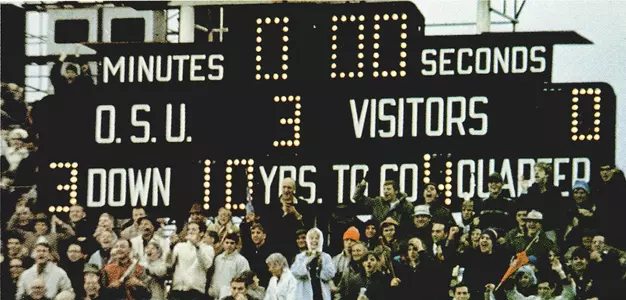
A series later, Sogge fumbled at the USC 47 and OSU linebacker Skip Vanderbundt recovered. Eight rushes put the Beavers at the Trojan 14, and Mike Haggard's 30-yard field goal snuck just inside the right upright to give Oregon State a 3-0 lead 5:02 before halftime.
"When I made it, I never figured that would be enough for us to win," Haggard told reporters after the game. He had a chance to extend the lead later in the quarter but missed a 28-yard kick wide right.
Many fans had missed that action. Thousands heading south for the contest on Interstate 5 had to contend with being funneled from the freeway onto two-lane U.S. Highway 34 into Corvallis; the result was a nine-mile traffic jam. Oregon State Police Lt. Robert White later told the Oregon Statesman newspaper, "The last of the traffic got in at the half."
The final two quarters were a battle of defense and field position. After the Beavers took their 3-0 lead, OSU punter Gary Houser forced USC to start its possessions at its own 31, 19, 19, 20, 25, 35, 24 and 20-yard lines. The Trojans earned only three first downs in the game's final 44 minutes.
Southern California did reach the Oregon State 42 early in the third quarter but Boley dropped Sogge for a two-yard loss on third-and-1. OSU had a scoring chance of its own after Lewis recovered a Simpson fumble, but Haggard came up short on a 45-yard field goal try.
Other than that, it was the Beavers finding the fortitude to contain the explosive Trojans and cling to that 3-0 edge as McCall and Reagan watched from a box in the back row of the stands.
Noted The Oregonian of the game's final minutes: "As tension mounted in the fourth quarter, more and more fans below the governors turned around to see their reactions. McCall by this time was beginning to see the box of oranges in sight, part of a bet with Reagan, and leaped to his feet to urge the Beavers goalward with his cowboy hat aiming the way. Reagan, who stood to win a silver salmon in the event of an SC victory, summed up his feelings: 'You people can't get into the ratings, but you sure can knock everyone else out.'"
In those last three minutes, the Beavers managed their only two first downs of the second half, enabling them to run out the clock. When the final gun sounded, Oregon State students rushed the field and surrounded the Beavers, who were carrying Andros off the field.

In the locker room in the basement of Gill Coliseum, Andros climbed on a box and called for silence, then held up his right hand with its index finger extended.
"Who's No. 1 now?" he shouted. Wrote Bob Robinson in The Oregonian, "His players – also giving the No. 1 sign – rocked Gill Coliseum with a roar that never before has been matched in the historic athletic plant."
Asked OSU defensive halfback Don Whitney: "Got any more No. 1 or No. 2 teams we can play?" Added Beaver quarterback Steve Preece, "Maybe now we'll crack the top 10."
The final statistics bore testament to the nature of the game. Oregon State had 204 yards total offense, 196 of that rushing; Southern California gained 210 yards, 200 on the ground. USC attempted just 10 passes and completed four, while OSU tried a mere four passes, completing one. The Beavers had managed eight first downs and punted nine times; the Trojans had nine first downs and eight punts.
"Our defense played the greatest game I have ever seen," said OSU fullback Bill Enyart, who rushed for 135 yards on 24 carries. "I can't believe it yet."
To Oregon State split end Roger Cantlon, the scene seemed like a hard-to-believe dream.
"We've seen them on TV and seen their movies and we've talked about how great they were and thought we'd never make it," Cantlon said. "But here we are … I'm still so nervous … still so psyched up that I could go out there right now and play another game."
The Beavers awarded the game ball to Bob Jeremiah, a reserve defensive guard. The next day, Jeremiah, a junior from Cottage Grove, would be inducted into the U.S. Marine Corps.
"I tell you," Andros shared with reporters, "He was so touched and so proud, he cried a little. But, heck, I was crying a little, too." Andros was a former Marine who had earned the Bronze Star for his actions in battle on Iwo Jima in World War II.
On the other side of Gill Coliseum, USC head coach John McKay was subdued when he faced reporters.
"We performed well for most of the game," McKay said. "They just performed better."
As for the field?
"It was muddy," McKay said. "But if we had the best team, we would have won on a muddy field."
Regardless of the conditions, Simpson finished with 188 yards on 31 carries.
"He's the best that we've faced," Boley said. "But he can have that Heisman Trophy. We'll settle for the win."
The Beavers headed out for a night of celebration, some perhaps planning on coming back to Gill Coliseum to watch another Los Angeles group that recently been No. 1: Jim Morrison and The Doors, whose "Light My Fire" had topped the Billboard Top 40 in July.
But, on this night in Corvallis, the renowned rock-and-rollers were a distant second in celebrity to the Giant Killers.
Historian Kip Carlson is in the midst of writing a six-part series on the team that originally prints in the gameday program that is available at Reser Stadium.
The Giant Killers were honored at the Oct. 14 game vs. Colorado.
Bring on No. 1
It didn't take long for Dee Andros to issue the challenge: "We're tired of fooling around with these Number 2 teams – bring on Number 1!"
It was the afternoon of November 4, 1967, and his Oregon State football team had just tied second-ranked UCLA 16-16 in Los Angeles' Memorial Coliseum; two weeks earlier, the Beavers had won 22-14 at second-ranked Purdue. And the third-year OSU head coach – and everyone in Oregon – knew what was next:
No. 1 Southern California, back home in Parker Stadium.
"Our kids know they're playing No. 1 next week," Andros said not long after about 1,000 fans met the Beavers upon their return from UCLA. "And they welcome the challenge. When you're playing the best team in the country, you better be ready."
The Trojans carried an 8-0 record into the week, fresh off a 31-12 win at California. And they'd bring a weapon to Corvallis they hadn't had against the Bears: Orenthal James Simpson, better known as O.J. and thus nicknamed "Orange Juice." Simpson was the nation's rushing leader with 1,050 yards and nine touchdowns despite missing not only the Cal game but also most of the last half of the previous week's 28-6 win over Oregon. Having recovered from an injured arch, Simpson was expected to be at 100 percent against OSU.
"We're looking forward to the challenge," Andros said.
The Beavers were gaining notoriety of their own. Now 5-2-1 and with the success against second-ranked teams, Oregon State was ranked No. 13 in the United Press International coaches poll; in those years, the Associated Press poll of sportswriters and sportscasters still ranked only 10 teams.
If OSU's penchant for upsets put the game against Southern California on the map nationally, then locally it made it the center of near mania. This would be the first time USC had ever played in Corvallis; Oregon State's previous home games against the Trojans had been played in Portland. It would also be the first time a No. 1-ranked team had played in the state.
Parker Stadium's offseason addition of 8,000 seats to the west grandstand had come at an opportune time, as the new capacity of 40,750 might be tested. By early in the week of the game, reserved tickets on the sidelines were sold out and general admission tickets were going fast, priced at $2.50 for adults, $1.00 for high school students and 50 cents for any Boy Scout in uniform.
The game would be preceded by a Salute to Veterans pageant held in conjunction with the nation's largest Veterans Day celebration held in nearby Albany. Oregon Gov. Tom McCall and California Gov. Ronald Reagan would both ride in the Albany parade, then attend the football game; they'd be joined by Lt. Gen. Jimmy Doolittle, who had led a daring bombing raid over Tokyo early in World War II and a number of Congressional Medal of Honor winners.
In addition, Oregon State's 1941 team that played in the 1942 Rose Bowl would be on hand as part of its 25th anniversary reunion weekend. Those Beavers had upset second-ranked Duke 20-16 in the "transplanted" bowl game in Durham, N.C.
The week promised on-and-off rain showers, leading Los Angelenos to wonder whether OSU's field would be grass or mud for the showdown; USC athletic director Jess Hill telephoned his Oregon State counterpart, Jim Barratt, to ask whether the Parker Stadium field had been covered, only to be told OSU had no tarp.
Speculation was that a dry field would favor the Trojans and their speedy, shifty Simpson, but Andros wanted solid footing as well.
"Sure, maybe a wet field would slow up O.J., but it would slow our attack, too," Andros said. "We like to get to the outside as we did against UCLA – on a fast field."
Despite OSU's recent success, the Rose Bowl hopes at stake in the game were mainly USC's. With the Pacific-8 having only reformed in the past several years, rejoining schools from the old Pacific Coast Conference that had broken apart in the late 1950s, there was not yet a round-robin schedule; the Beavers needed to beat USC and Oregon, have Washington beat UCLA, and then have USC and UCLA tie.
But for the moment, the Beavers versus the Trojans was all that mattered.
The Corvallis Gazette-Times front page for Friday morning, November 10, noted the city's hotels and motels were at capacity and city police officers and Benton County sheriff's deputies would have their hands full directing traffic. On the same page, another story told of the three-legged spacecraft Surveyor 6 sending photos from the moon; its voyage was considered a big step in the mission being planned to send three astronauts to the lunar surface three years hence. There was an account of President Lyndon Johnson telling U.S. soldiers at Fort Benning, Ga., that the nation's hopes and dreams depended on bringing unity to the Vietnam battleground "where our beliefs and future are at test." And at the bottom of the page was a story about students living on the third floor of OSU's Wilson Hall trying to set a world record for continuous showering: 240 hours.
The weather forecast: "Rainy through Saturday … high near 55, with winds southerly 15-25 mph."
Bob Blackburn, the radio announcer working his final season for OSU before becoming the voice of Seattle's new National Basketball Association franchise, would call the game wearing a tuxedo – it had become a superstition over the past several weeks. For the Purdue game, Blackburn had arrived shortly before kickoff after an overnight flight; he hadn't had a chance to change from the tux he wore at an event in Seattle the previous evening. After the win, Andros told Blackburn he had to continue wearing the formal attire as long as the Beavers were winning.
Blackburn's station, KEX-AM in Portland, had a telegram delivered to the Beavers signed by over 4,000 listeners; it read: "To us you are No. 1. We know you can deliver the biggest upset of the year. If support from the fans could score touchdowns, you would already have won. USC has the reputation but you have the ability. Beat the Trojans."
Now all the Beavers had to do was go out and do it.
The game had sold out, and then some: a crowd of 41,494 – the largest ever to see an athletic event in the state to that time - eventually wedged its way into Parker Stadium.
Simpson was as advertised, rushing for 87 yards in the first quarter alone. His carries of 22 and 18 yards helped USC to the OSU 18-yard line, but Rikki Aldridge's 26-yard field goal try went wide right.
Early in the second quarter, Simpson looked headed for the game's initial score when he took a handoff from the Trojan 31, broke a tackle at the 37, then cut to the left sideline and found plenty of running room. Safety Mark Waletich was the last Beaver between him and the goal line, but Simpson had a pair of blockers getting Waletch in their sights.
However, Beaver defensive tackle Jess Lewis never gave up on pursuit. He came across the field and managed to drag Simpson down from behind at the Oregon State 32; the play remains one of the legendary moments in Oregon State history. The threat ended when OSU defensive tackle Ron Boley stopped USC quarterback Steve Sogge on a fourth-and-2 play from the Beaver 24.
A series later, Sogge fumbled at the USC 47 and OSU linebacker Skip Vanderbundt recovered. Eight rushes put the Beavers at the Trojan 14, and Mike Haggard's 30-yard field goal snuck just inside the right upright to give Oregon State a 3-0 lead 5:02 before halftime.
"When I made it, I never figured that would be enough for us to win," Haggard told reporters after the game. He had a chance to extend the lead later in the quarter but missed a 28-yard kick wide right.
Many fans had missed that action. Thousands heading south for the contest on Interstate 5 had to contend with being funneled from the freeway onto two-lane U.S. Highway 34 into Corvallis; the result was a nine-mile traffic jam. Oregon State Police Lt. Robert White later told the Oregon Statesman newspaper, "The last of the traffic got in at the half."
The final two quarters were a battle of defense and field position. After the Beavers took their 3-0 lead, OSU punter Gary Houser forced USC to start its possessions at its own 31, 19, 19, 20, 25, 35, 24 and 20-yard lines. The Trojans earned only three first downs in the game's final 44 minutes.
Southern California did reach the Oregon State 42 early in the third quarter but Boley dropped Sogge for a two-yard loss on third-and-1. OSU had a scoring chance of its own after Lewis recovered a Simpson fumble, but Haggard came up short on a 45-yard field goal try.
Other than that, it was the Beavers finding the fortitude to contain the explosive Trojans and cling to that 3-0 edge as McCall and Reagan watched from a box in the back row of the stands.
Noted The Oregonian of the game's final minutes: "As tension mounted in the fourth quarter, more and more fans below the governors turned around to see their reactions. McCall by this time was beginning to see the box of oranges in sight, part of a bet with Reagan, and leaped to his feet to urge the Beavers goalward with his cowboy hat aiming the way. Reagan, who stood to win a silver salmon in the event of an SC victory, summed up his feelings: 'You people can't get into the ratings, but you sure can knock everyone else out.'"
In those last three minutes, the Beavers managed their only two first downs of the second half, enabling them to run out the clock. When the final gun sounded, Oregon State students rushed the field and surrounded the Beavers, who were carrying Andros off the field.
In the locker room in the basement of Gill Coliseum, Andros climbed on a box and called for silence, then held up his right hand with its index finger extended.
"Who's No. 1 now?" he shouted. Wrote Bob Robinson in The Oregonian, "His players – also giving the No. 1 sign – rocked Gill Coliseum with a roar that never before has been matched in the historic athletic plant."
Asked OSU defensive halfback Don Whitney: "Got any more No. 1 or No. 2 teams we can play?" Added Beaver quarterback Steve Preece, "Maybe now we'll crack the top 10."
The final statistics bore testament to the nature of the game. Oregon State had 204 yards total offense, 196 of that rushing; Southern California gained 210 yards, 200 on the ground. USC attempted just 10 passes and completed four, while OSU tried a mere four passes, completing one. The Beavers had managed eight first downs and punted nine times; the Trojans had nine first downs and eight punts.
"Our defense played the greatest game I have ever seen," said OSU fullback Bill Enyart, who rushed for 135 yards on 24 carries. "I can't believe it yet."
To Oregon State split end Roger Cantlon, the scene seemed like a hard-to-believe dream.
"We've seen them on TV and seen their movies and we've talked about how great they were and thought we'd never make it," Cantlon said. "But here we are … I'm still so nervous … still so psyched up that I could go out there right now and play another game."
The Beavers awarded the game ball to Bob Jeremiah, a reserve defensive guard. The next day, Jeremiah, a junior from Cottage Grove, would be inducted into the U.S. Marine Corps.
"I tell you," Andros shared with reporters, "He was so touched and so proud, he cried a little. But, heck, I was crying a little, too." Andros was a former Marine who had earned the Bronze Star for his actions in battle on Iwo Jima in World War II.
On the other side of Gill Coliseum, USC head coach John McKay was subdued when he faced reporters.
"We performed well for most of the game," McKay said. "They just performed better."
As for the field?
"It was muddy," McKay said. "But if we had the best team, we would have won on a muddy field."
Regardless of the conditions, Simpson finished with 188 yards on 31 carries.
"He's the best that we've faced," Boley said. "But he can have that Heisman Trophy. We'll settle for the win."
The Beavers headed out for a night of celebration, some perhaps planning on coming back to Gill Coliseum to watch another Los Angeles group that recently been No. 1: Jim Morrison and The Doors, whose "Light My Fire" had topped the Billboard Top 40 in July.
But, on this night in Corvallis, the renowned rock-and-rollers were a distant second in celebrity to the Giant Killers.

Wednesday, October 07
Wednesday, October 07
Tuesday, October 06
Tuesday, October 06